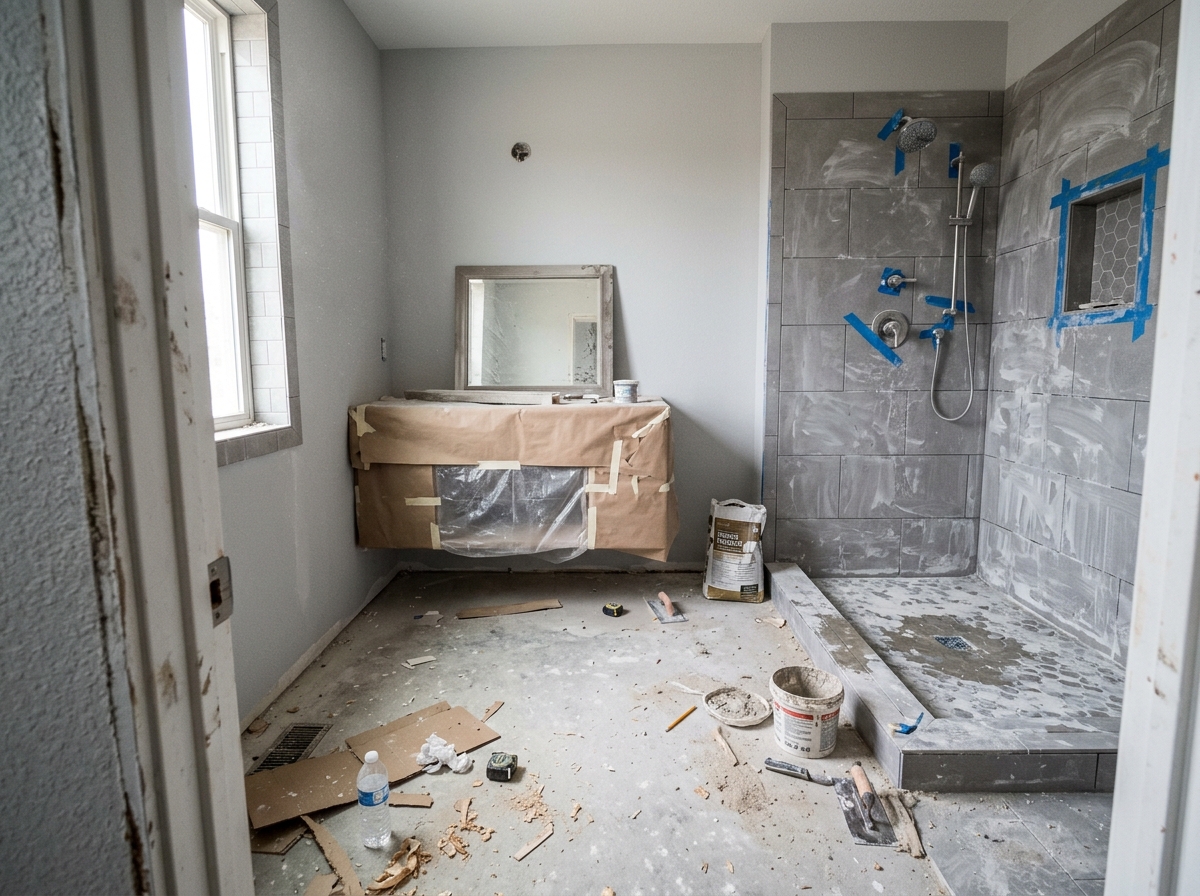
You just spent $8,000 on a new Carrara shower and now it looks like someone spray-painted it with diluted concrete. That's grout haze — and it's the single most common call we get from Boston homeowners post-renovation.
What grout haze is.
When tile installers grout a fresh install, they work excess grout into the joints. After it dries, they wipe the tile surface. But some grout residue remains on the tile face as a microscopic cementitious film. As it dries, it looks like a faint gray or white cloud — especially on dark tile or polished stone.
Most tile installers leave this for the cleaning crew to remove. That's industry standard. But a lot of homeowners try to remove it themselves first, and the results are usually bad.
Why DIY fails.
- Wrong chemical, permanent damage. Acid-based cleaners eat calcium-based stones.
- Wrong pad, scratched surface. Abrasive scrub pads on polished porcelain or ceramic leave micro-scratches you see the first time sunlight hits.
- Pushing haze into grout lines. Bad technique drives the residue deeper and darkens your grout permanently.
- Streaky final result. Without proper rinse cycles, haze reappears after it dries.
How pros remove it.
Professional grout haze removal is a specific 4-step process. Each step matters:
- Identify the stone/tile. Natural stone needs acid-free products. Porcelain and ceramic tolerate mild acid. Get this wrong and you destroy the tile.
- Test in hidden area. Every chemical gets tested in a closet or under an appliance first. Always.
- Apply correct product. On ceramic/porcelain: sulfamic-acid-based grout haze remover, diluted, with controlled dwell time (2-5 min). On natural stone: enzymatic haze remover, no acid.
- Neutralize + rinse twice. Any residue left behind accelerates efflorescence later. Two-step rinse with fresh water, microfiber buff dry.
What it costs in Boston.
In Greater Boston, grout haze removal runs:
- Standard ceramic/porcelain — $2-$4/sq ft of tile surface. A 100 sq ft bathroom is $200-$400.
- Natural stone — $4-$8/sq ft. More delicate, more labor.
- Part of full post-construction scope — usually included at no extra charge on our post-con jobs.
How to prevent it next time.
If you're a GC or homeowner planning a tile install:
- Ask the tile installer to do a thorough post-grout wipe-down with clean sponges and fresh water — not the same sponge they grouted with.
- Schedule post-construction cleanup within 3-5 days of grouting. The longer it cures, the harder it is to remove.
- Never let drywall dust settle onto freshly-grouted tile before cleaning. Dust + haze = a nightmare.
Grout haze on a new install?
Send us a photo. We'll tell you if it's DIY-able or not — and quote either way.