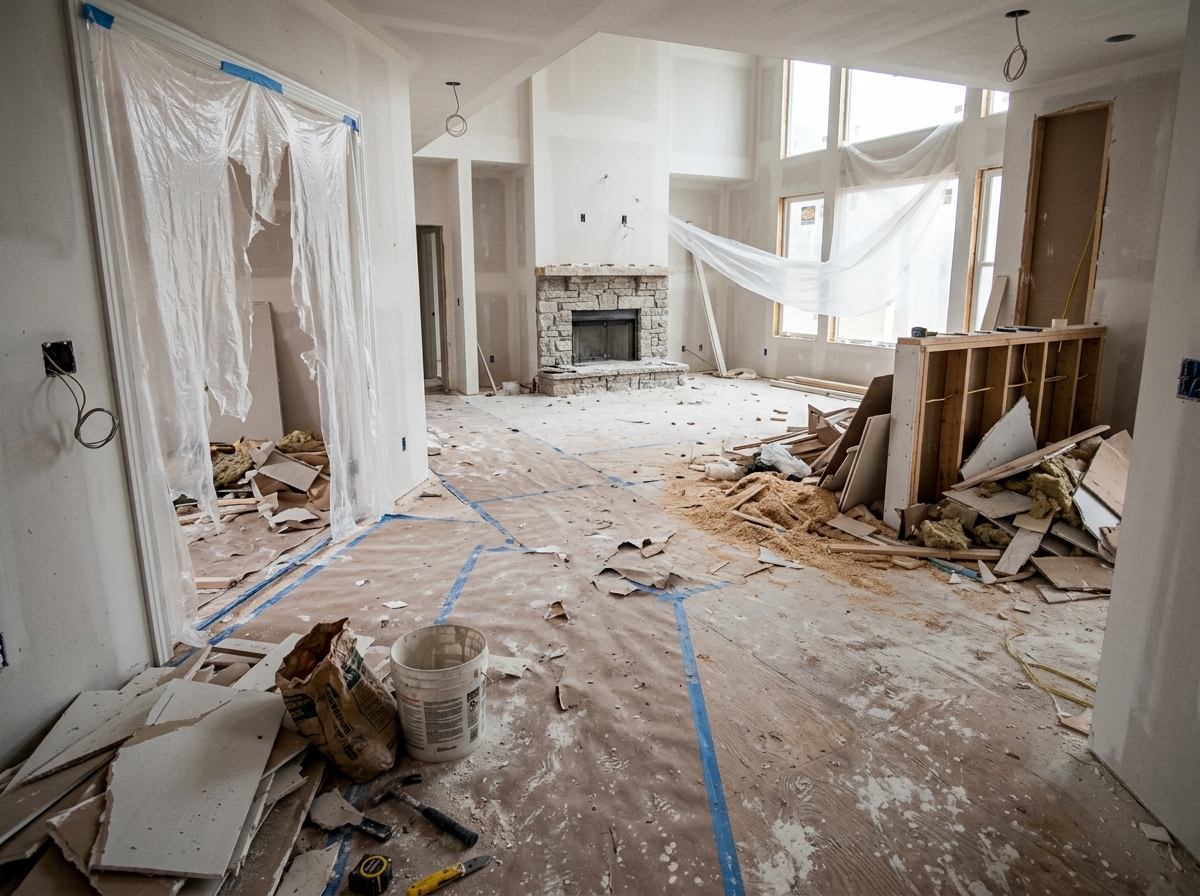
If your crew is using a shop-vac or a Dyson to clean up drywall dust, you have a problem. A big one. Most of that dust isn't going into the vacuum — it's going into the air, the HVAC system, and the lungs of whoever walks through on handover day.
Here's the technical reality most contractors don't hear, and what you should require on every post-construction cleanup in Boston.
How small is drywall dust?
Drywall dust particles range from 0.3 to 5 microns. For context:
| Particle | Size (microns) |
|---|---|
| Human hair | 70 |
| Pollen | 10-100 |
| Fine drywall dust | 0.3-5 |
| Bacteria | 0.3-60 |
| HEPA filter target | captures 99.97% at 0.3 |
A standard shop-vac or household vacuum catches particles down to about 30-50 microns reliably. Below that, anything it "sucks up" gets blown out the exhaust in a cloud of fine dust.
What HEPA actually means.
HEPA = High Efficiency Particulate Air. A true HEPA filter captures 99.97% of particles at 0.3 microns. That 0.3 number isn't arbitrary — it's the hardest particle size to filter (anything smaller or larger is easier). So HEPA is the practical gold standard.
There are three grades you'll see marketed:
- True HEPA — independently tested, 99.97% @ 0.3µm. This is the real thing.
- "HEPA-type" / "HEPA-like" — marketing language. Captures 85-95% at best. Not the same.
- ULPA — ultra-low penetration, 99.999% @ 0.12µm. Used in labs, cleanrooms, biotech.
Why it matters for Boston post-con jobs.
- HVAC contamination. Fine drywall dust gets pulled into return air vents and spread through the whole system. A month later, every filter is grey and every surface gets a dust film.
- Respirable silica. Drywall dust contains small amounts of silica and gypsum. OSHA sets exposure limits. Non-HEPA cleanup extends exposure time for workers, homeowners, and move-in crews.
- Walkthrough surprises. Client runs their finger across the top of a cabinet → grey film → awkward conversation. HEPA catches it; shop-vacs don't.
- Historic and luxury finishes. Back Bay brownstones, South End condos, Seaport penthouses — fine dust embedded in lacquer, stone, or engineered wood is a nightmare to remove later.
What to require in your post-con contract.
If you're a Boston GC hiring a post-construction crew, put this in the scope or contract:
- "All vacuuming performed with HEPA-certified vacuums rated 99.97% at 0.3 microns."
- "Crew to provide make/model of vacuum equipment on request."
- "HVAC grille and return vent cleaning included in scope."
- "Final inspection includes flashlight test for airborne dust residue."
What we use at Blue Brick.
Every post-construction crew we send out has at least one ProTeam Super Coach HEPA backpack unit + one Nilfisk GM 80 for detail work. Both are true-HEPA rated. We also carry a secondary Festool CT-26 HEPA for tight finish work near newly-installed cabinets or trim.
This equipment costs us more upfront and more per visit. But the alternative is calling clients back in 3 weeks because their air filters are grey and their stone counters are fogged — and that's a worse outcome for everyone.
Need a post-con crew
that actually has HEPA?
Greater Boston, same-week scheduling, $2M COI, written scope. Quote in 2 hours.